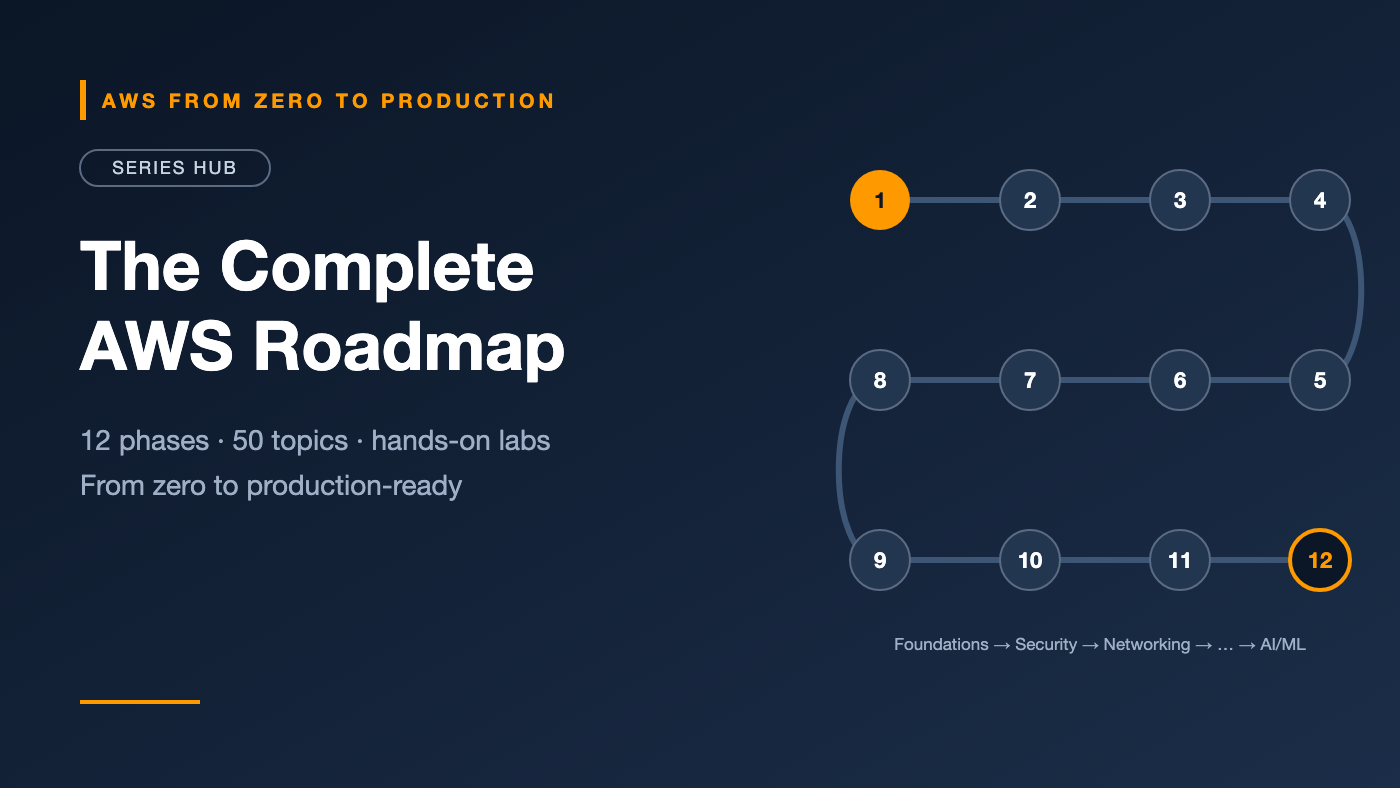
AWS from Zero to Production — Series Hub
AWS has hundreds of services.
Open the console for the first time, and it feels like walking into a library where every book is titled with an acronym. EC2. ECS. EKS. IAM. VPC. RDS. MWAA. Where do you even start?
Most people do one of two things. They watch random tutorials and end up with scattered knowledge that never quite connects. Or they give up.
This series is the third option: a structured path that takes you from “What is the cloud?” to designing and running a production-grade platform on AWS.
Every article builds on the last. Most phases end with a hands-on lab where you build something real. And by the end, you’ll be able to design, deploy, secure, monitor, and explain a complete system — the kind used by real engineering and data teams.
This page is the hub. Every article in the series is listed here, in order. Bookmark it and come back whenever you’re ready for the next step.
Who this series is for
- 🌱 Complete beginners who want to learn AWS properly, without skipping the foundations
- 👩💻 Developers who deploy to AWS but want to understand what’s happening underneath
- ⚙️ DevOps and platform engineers who want a structured, end-to-end refresher
- 📊 Data engineers who want to build data platforms on AWS — not just use them
You don’t need prior AWS experience. Each article explains its concepts in plain language first, then goes deeper into the engineering tradeoffs.
How each article works
Every article in the series follows the same pattern, so you always know what to expect:
- A real problem you’ll recognize
- The concepts, explained without jargon
- The tradeoffs experienced engineers think about
- A hands-on lab, where the phase includes one — with checkpoints, cost notes, and cleanup steps
- Common mistakes and key takeaways
- What’s next, so the path keeps moving
A note on cost: Labs are designed to be low-cost and include cleanup steps. Always set up a budget alert first — Phase 1 shows you how — and check current AWS pricing before creating resources.
What you’ll build by the end
Every phase adds a piece to one complete architecture. By the final phase, you’ll be able to build and explain this:
GitHub Actions
      |
      | OIDC (no stored AWS keys)
      v
AWS IAM Role
      |
      +------> Amazon ECR
      |             |
      |             v
      +------> Amazon ECS / Fargate
      |             |
      |             +------> Amazon RDS
      |             |
      |             +------> AWS Secrets Manager
      |
      +------> Amazon S3 Data Lake
                    |
                    +------> AWS Glue
                    +------> Amazon Athena
                    +------> Amazon Redshift
                    +------> AWS Lake Formation

Monitoring: Amazon CloudWatch + AWS CloudTrail
In plain English: code pushed to GitHub is tested and deployed automatically to a containerized application on AWS — with no long-lived AWS keys stored in GitHub. The application talks to a private database whose credentials are stored securely. Meanwhile, data flows into a governed data lake where it can be cataloged, queried, and analyzed. Everything is monitored and audited.
That’s not a toy project. That’s how real teams work.
The full roadmap
Phase 1: Cloud and AWS Foundations
Learn the language of the cloud and set up a safe place to experiment.
1.1 — The 7 Cloud Concepts Every AWS Engineer Must Know (Before Touching a Single Service) IaaS vs. PaaS vs. SaaS, scalability vs. elasticity, high availability, disaster recovery, and the shared responsibility model. Read →
1.2 — “Where Did My Database Go?” — AWS Regions and Availability Zones, Finally Explained Regions, AZs, edge locations, choosing a Region, and multi-AZ vs. multi-Region. Read →
1.3 — One AWS Account for Everything? Here’s Why That Eventually Breaks Root user security, multi-account strategy, AWS Organizations, SCPs, and Control Tower. Read →
1.4 — The AWS Bill Nobody Warned You About (And How to Never Get One) Pricing models, hidden costs, the Free Tier, Budgets, Cost Explorer, and support plans. Read →
1.5 — Do This Before You Build Anything on AWS: A 60-Minute Secure Setup 🛠️ Lab MFA, budget alerts, IAM Identity Center, and an AWS CLI with no permanent access keys. Read →
Phase 2: Identity, Security, and Governance
Control who can do what — the most important skill in AWS.
2.1 — AccessDenied? The IAM Mental Model That Makes AWS Permissions Finally Click Users, groups, roles, policies, policy evaluation logic, and temporary credentials with STS. Read →
2.2 — Beyond AdministratorAccess: Advanced IAM That Real Teams Use Trust policies, cross-account access, permissions boundaries, ABAC, and IAM Access Analyzer. Read →
2.3 — Delete Your AWS Access Keys: How OIDC and Federation Replace Them SAML, OIDC, GitHub Actions authentication, and the 2026 change to subject claims. Read →
2.4 — Where Should That Password Live? Encryption and Secrets on AWS KMS, envelope encryption, Secrets Manager, Parameter Store, and ACM. Read →
2.5 — Who Changed That? CloudTrail, Config, GuardDuty, and the AWS Security Toolbox Audit trails, configuration history, threat detection, and compliance evidence. Read →
2.6 — Deploy From GitHub Actions to AWS Without a Single Access Key 🛠️ Lab A GitHub OIDC deployment role locked to one repository and environment. Read →
Phase 3: Networking
Understand how traffic flows — and how to keep the wrong traffic out.
3.1 — “Connection Timed Out”: The Networking Basics Every AWS Engineer Needs IP addresses, CIDR, ports, DNS, routing, NAT, firewalls, load balancing, and TLS. Read →
3.2 — Public or Private? Your First AWS VPC, Explained Subnets, route tables, internet and NAT gateways, security groups, NACLs, and flow logs. Read →
3.3 — One VPC Is Never Enough: Peering, Transit Gateway, PrivateLink, and Hybrid Networks VPC endpoints, VPNs, Direct Connect, hybrid DNS, Network Firewall, and shared VPCs. Read →
3.4 — From Domain Name to Edge Cache: Route 53, CloudFront, WAF, and Shield Hosted zones, routing policies, health checks, CloudFront caching, OAC, and DDoS protection. Read →
3.5 — Build a Production-Shaped AWS Network: Two AZs, a Load Balancer, and Private Tiers 🛠️ Lab A two-AZ VPC with a public Application Load Balancer and app servers that have no public IP. Read →
Phase 4: Compute and Application Hosting
Run your code on AWS — from virtual machines to containers to serverless.
4.1 — Stop SSHing Into Servers: Amazon EC2 Done Right Instance types, AMIs, user data, EBS, pricing models, placement groups, and Session Manager. Read →
4.2 — Survive Traffic Spikes Automatically: Load Balancers and Auto Scaling on AWS ALB, NLB, and GWLB, target groups, health checks, launch templates, and scaling policies. Read →
4.3 — Containers on AWS Without the Confusion: Docker, ECR, and ECS Explained Images, ECR scanning, task definitions, services, task vs. execution roles, Fargate, and deployments. Read →
4.4 — Do You Really Need Kubernetes? Amazon EKS, Explained Honestly Kubernetes basics, node groups, Fargate profiles, Pod Identity, Karpenter, and ECS vs. EKS. Read →
4.5 — No Servers, No Problem? AWS Lambda and the Serverless Toolkit Lambda, concurrency, API Gateway, Step Functions, EventBridge, SNS, SQS, DLQs, and SAM. Read →
4.6 — Ship Your First Container to AWS: An API on ECS Fargate Behind a Load Balancer 🛠️ Lab Build, push, and run a containerized API in private subnets — then deploy v2 with zero downtime. Read →
Phase 5: Storage and Databases
Store files, records, and state — safely and at the right cost.
5.1 — Amazon S3 Is Not Just a Folder in the Cloud Storage classes, lifecycle rules, versioning, Object Lock, bucket policies, events, and presigned URLs. Read →
5.2 — Backups You’ve Never Restored Aren’t Backups: EBS, EFS, FSx, and AWS Backup Volume types, snapshots, shared file systems, backup vaults, cross-account copies, and restore testing. Read →
5.3 — Your Database Will Fail. Here’s How RDS and Aurora Keep You Running Subnet and parameter groups, backups, Multi-AZ vs. read replicas, RDS Proxy, and Aurora Serverless. Read →
5.4 — DynamoDB Is Fast — If You Design It Right: NoSQL and Caching on AWS Keys, indexes, capacity modes, streams, TTL, global tables, ElastiCache, and MemoryDB. Read →
5.5 — Connect Your Container to a Private Database — With No Passwords in Code 🛠️ Lab Private RDS PostgreSQL, an RDS-managed secret, backups, and an app that survives live password rotation. Read →
Phase 6: Infrastructure as Code and Automation
Stop clicking. Start codifying.
6.1 — Stop Clicking Around the Console: Infrastructure as Code With CloudFormation Templates, intrinsic functions, change sets, nested stacks, StackSets, drift, and rollbacks. Read →
6.2 — Terraform on AWS: State, Modules, and the Mistakes That Lock Your Team Out Providers, modules, remote state in S3 with locking, workspaces, imports, and secrets. Read →
6.3 — Infrastructure in TypeScript or Python? The AWS CDK, Explained Constructs, stacks, environments, synth, diff, deploy, reusable constructs, and CDK Pipelines. Read →
6.4 — The AWS Service That Runs Your Fleet While You Sleep: Systems Manager Parameter Store, Session Manager, Run Command, Patch Manager, Automation, and State Manager. Read →
6.5 — Rebuild Everything With One Command: Your AWS Stack in Terraform 🛠️ Lab The VPC, ECR, ECS, RDS, IAM, and CloudWatch alarms as code — plus drift detection. Read →
Phase 7: CI/CD and DevOps
Ship changes safely, automatically, and often.
7.1 — Merge, Build, Ship, Repeat: The CI/CD Fundamentals Behind Every Great Team Branching, pull requests, SemVer, pipeline stages, promotion, rollbacks, blue-green, and canary. Read →
7.2 — GitHub Actions + AWS: The Complete Guide for Real Deployments Workflows, runners, environments, reusable workflows, caching, OIDC, ECR, ECS, and hardening. Read →
7.3 — CodePipeline, CodeBuild, and CodeDeploy: CI/CD Without Leaving AWS Buildspecs, deployment groups, ECS blue-green, Lambda traffic shifting, approvals, and notifications. Read →
7.4 — Shift Left Without Slowing Down: DevSecOps on AWS SAST, SCA, container, IaC, and secret scanning, Amazon Inspector, SBOMs, signing, and policy as code. Read →
7.5 — One Push to Production: A Pipeline That Tests, Scans, Deploys, and Rolls Back 🛠️ Lab GitHub Actions with OIDC, a vulnerability gate, ECS deployment, smoke tests, and automatic rollback. Read →
Phase 8: Monitoring, Reliability, and Operations
Know what’s happening in production before your users tell you.
8.1 — If You Can’t See It, You Can’t Fix It: Amazon CloudWatch Explained Metrics, logs, metric filters, Logs Insights, alarms, composite alarms, anomaly detection, and dashboards. Read →
8.2 — It’s Broken. Now What? Auditing and Troubleshooting on AWS CloudTrail, Config, flow logs, access logs, RDS logs, ECS events, the Health Dashboard, and a playbook. Read →
8.3 — Everything Fails, All the Time: Reliability Engineering on AWS RTO and RPO, DR strategies, multi-AZ and multi-Region, fault injection, Resilience Hub, and incidents. Read →
8.4 — Is Your Architecture Actually Good? The AWS Well-Architected Framework The six pillars, the Well-Architected Tool, lenses, workload reviews, and improvement plans. Read →
8.5 — Build the Dashboard You’ll Actually Use at 3 A.M. 🛠️ Lab A golden-signals CloudWatch dashboard in Terraform — then diagnose a database outage from one screen. Read →
Phase 9: Data Engineering on AWS
Turn raw data into something the business can actually use.
9.1 — OLTP, OLAP, ETL, ELT: Data Engineering Fundamentals for Cloud Engineers Batch vs. streaming, lakes, warehouses, and lakehouses, partitioning, formats, quality, and governance. Read →
9.2 — Data Lake or Data Swamp? Designing an S3 Data Lake That Stays Clean Zones, prefixes, partitions, Parquet and Avro, the small-file problem, lifecycle, and encryption. Read →
9.3 — AWS Glue Without the Guesswork: Catalog, Crawlers, and Spark ETL The Data Catalog, crawlers, PySpark jobs, bookmarks, worker types, workflows, and Data Quality. Read →
9.4 — Query Terabytes With Plain SQL: Amazon Athena Done Right Partitions and projection, CTAS, workgroups, federation, Iceberg, and cost controls. Read →
9.5 — When Athena Isn’t Enough: Amazon Redshift for Data Warehousing Serverless, distribution and sort keys, COPY and UNLOAD, Spectrum, WLM, and data sharing. Read →
9.6 — Spark at Scale: Amazon EMR and the Art of Big Data Processing EMR on EC2, Serverless, and EKS, shuffles, skew, memory, Spot, and troubleshooting. Read →
9.7 — Data That Never Stops: Streaming on AWS With Kinesis and MSK Shards, Firehose, Flink, Kafka, delivery guarantees, windows, late events, and Lambda. Read →
9.8 — Who Runs the Pipeline at 2 A.M.? Data Orchestration on AWS Step Functions, MWAA, EventBridge Scheduler, retries, idempotency, backfills, and observability. Read →
9.9 — Getting Data In: DMS, Change Data Capture, and Every Way to Ingest on AWS DMS full load and CDC, schema conversion, DataSync, Transfer Family, AppFlow, and validation. Read →
9.10 — Who Can See the Salary Column? Data Governance With Lake Formation and Macie Column, row, and tag-based access, data sharing, PII detection, masking, retention, and lineage. Read →
9.11 — Build an End-to-End Data Platform on AWS: From Database to Dashboard 🛠️ Lab DMS to S3, Glue to curated Parquet, Athena and Redshift, Step Functions, and SNS alerts. Read →
Phase 10: Architecture and Advanced AWS
Design systems that scale, survive failure, and don’t waste money.
10.1 — Stop Calling, Start Reacting: Event-Driven Architecture on AWS EventBridge, SNS, SQS, DLQs, replay, idempotent consumers, Pipes, and choreography vs. orchestration. Read →
10.2 — Designing Systems That Don’t Fall Over: Distributed Patterns on AWS Statelessness, caching, timeouts, circuit breakers, bulkheads, throttling, and the saga pattern. Read →
10.3 — When a Region Goes Dark: High Availability and Disaster Recovery in Practice Single-AZ risks, cross-Region replication, database and DNS failover, runbooks, and the cost of nines. Read →
10.4 — Your AWS Bill Is a Design Document: Cost and Performance Optimization Rightsizing, Savings Plans, Spot, NAT and data transfer costs, serverless and database tuning, and FinOps. Read →
Phase 11: Artificial Intelligence and Machine Learning
Add AI to your platform — the practical way.
11.1 — AI Without the Hype: ML and Generative AI Fundamentals for Engineers The ML lifecycle, evaluation, responsible AI, foundation models, embeddings, vector databases, and RAG. Read →
11.2 — Bedrock, SageMaker, and the AI You Don’t Have to Train: AI Services on AWS Bedrock models, Knowledge Bases, Agents, and Guardrails, SageMaker AI, and ready-made AI services. Read →
11.3 — Build a RAG App on AWS: Ask Questions About Your Own Documents 🛠️ Lab A Bedrock Knowledge Base over S3 documents, answers with citations, Guardrails, and least-privilege IAM. Read →
Phase 12: Certification Path (Optional)
Certifications aren’t required — but they’re useful, measurable milestones.
12.1 — Your AWS Certification Roadmap — and the Capstone That Ties It All Together Which certifications to take and when, how they map to this series, how to study, and a full capstone walkthrough. Read →
Suggested timeline
Learning at a steady pace alongside a job? Here’s a realistic 12-month plan:
- 🗓️ Months 1–2 — Foundation: Phases 1–3 (fundamentals, IAM, security, VPC, networking, DNS)
- 🗓️ Months 3–4 — Core Engineering: Phases 4–6 (EC2, ECS, Lambda, S3, RDS, DynamoDB, Infrastructure as Code)
- 🗓️ Months 5–6 — DevOps: Phases 7–8 (GitHub Actions, OIDC, CI/CD, monitoring, logging, reliability)
- 🗓️ Months 7–9 — Data Engineering: Phase 9 (data lake, Glue, Athena, Redshift, EMR, streaming, orchestration, governance)
- 🗓️ Months 10–12 — Advanced Architecture: Phases 10–11 (distributed systems, event-driven design, cost, multi-Region, AI/ML, Bedrock)
Faster or slower is fine. What matters is finishing each lab before moving on — that’s where the real learning happens.
Optional: the certification path
If you want formal milestones, this sequence lines up well with the series:
- Foundation: AWS Certified Cloud Practitioner — after Phase 1
- Architecture: AWS Certified Solutions Architect – Associate — after Phases 2–8
- Data Engineering: AWS Certified Data Engineer – Associate — after Phase 9
- Operations or Development: AWS Certified CloudOps Engineer – Associate, or AWS Certified Developer – Associate — depending on your role
- Advanced: a Professional or Specialty certification, such as Solutions Architect – Professional, DevOps Engineer – Professional, Generative AI Developer – Professional, or Security – Specialty — after substantial hands-on experience
AWS updates its certification catalog regularly. Check the official AWS Certification page for current exams before you plan. Part 12.1 covers the full path in detail, including the AI certifications.
How to get the most out of this series
- ✅ Follow the order. Each phase assumes the ones before it.
- ✅ Do the labs. Reading builds understanding; building builds skill.
- ✅ Set a budget alert first. It takes five minutes and saves a lot of stress.
- ✅ Clean up after every lab. Unused resources are the #1 source of surprise bills.
- ✅ Write down what confused you. Then share it in the comments — I’ll use it to improve the series.
Start here
Ready? Begin with Phase 1, Part 1:
👉 The 7 Cloud Concepts Every AWS Engineer Must Know (Before Touching a Single Service) Start reading →
If this roadmap helped you, share it with someone who’s starting their AWS journey.