AWS from Zero to Production — Phase 12, Part 1 of 1 · See the full series roadmap
If you’ve followed this series from the start, look at what you’ve done.
You set up a secure AWS account. You built a VPC by hand. You shipped a container to ECS, connected it to a private database, and rotated its password live. You rebuilt everything in Terraform, deployed it from GitHub with no stored keys, and watched the pipeline roll itself back. You built a dashboard that diagnosed an outage in a minute, a data platform from a production database, and an AI assistant that cites its sources.
That’s not a tutorial collection. That’s the work of a cloud engineer.
This final article answers two questions: How do you prove it? And how does it all fit together?
What you’ll walk away with
- 🎓 The AWS certification levels, and what each is for
- 🗺️ A recommended certification path — and when to take each exam
- 🔗 How each certification maps to the phases of this series
- 📚 A study approach that builds real skill, not just exam recall
- 🏗️ A full walkthrough of the capstone architecture
- 🚀 What to do next
Are certifications worth it?
Certifications are optional. Hands-on skill is what makes you effective — and that’s what this series focused on.
But certifications are useful:
- They’re structured, measurable milestones that keep you learning.
- They push you into areas you’d otherwise skip.
- They’re a recognized signal to employers and clients — especially early in your career, or when changing roles.
- Some employers and partner programs require them.
The best approach: build first, then certify. The exam becomes a review of things you’ve done, not facts you memorized.
Certification levels
AWS organizes certifications into levels:
- Foundational: core concepts. No prior AWS experience required.
- Associate: role-based skills, with some hands-on experience.
- Professional: advanced design, operations, and AI development — for engineers with substantial experience.
- Specialty: deep expertise in a specific domain.
The current lineup
Foundational
- AWS Certified Cloud Practitioner
- AWS Certified AI Practitioner
Associate
- AWS Certified Solutions Architect – Associate
- AWS Certified Developer – Associate
- AWS Certified CloudOps Engineer – Associate
- AWS Certified Data Engineer – Associate
- AWS Certified Machine Learning Engineer – Associate
Professional
- AWS Certified Solutions Architect – Professional
- AWS Certified DevOps Engineer – Professional
- AWS Certified Generative AI Developer – Professional
Specialty
- AWS Certified Security – Specialty
- AWS Certified Advanced Networking – Specialty (scheduled to retire on December 31, 2026)
Check before you plan: AWS updates its catalog regularly — exams are added, renamed, updated, and retired. Always confirm the current exam and its exam guide on the AWS Certification site.
The recommended path
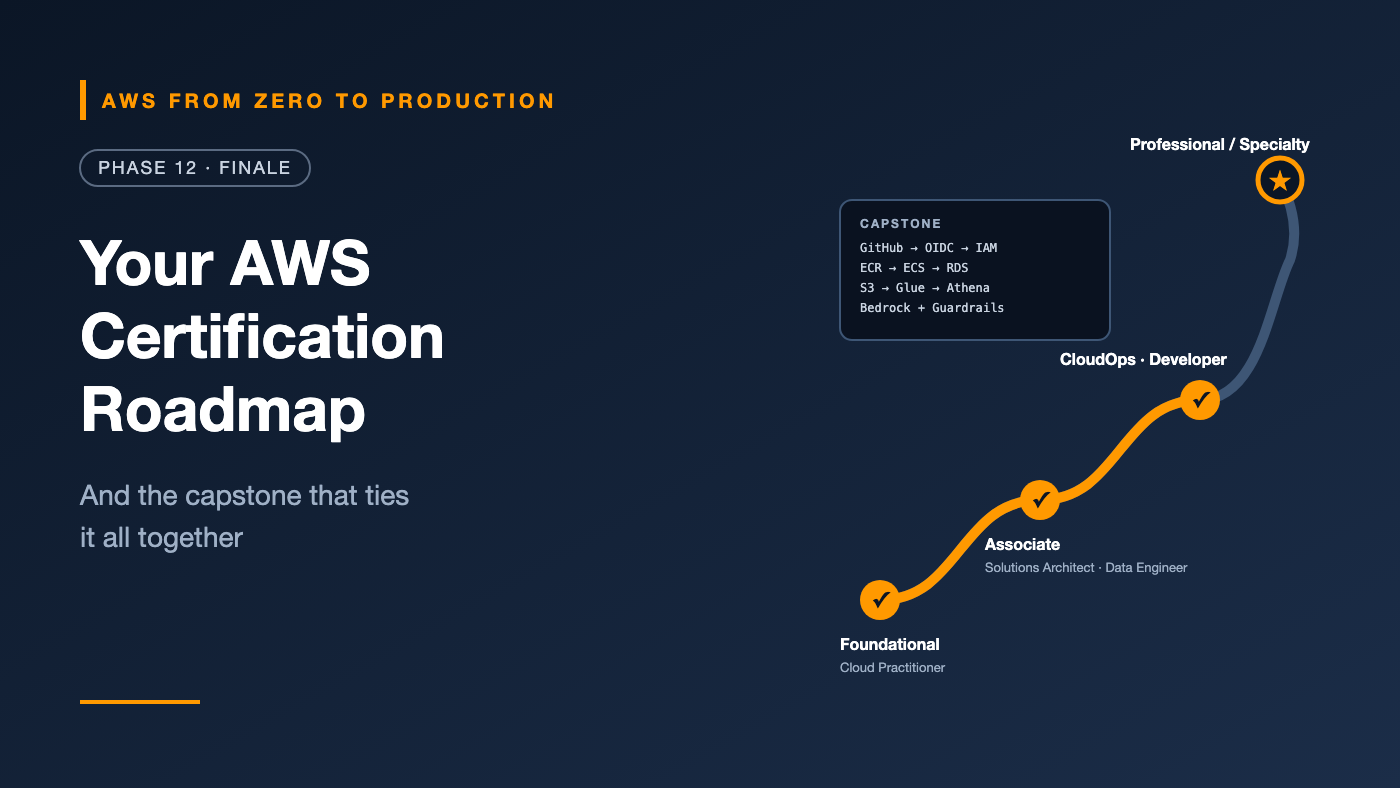
This path matches the series — and a career in cloud and data engineering.
Step 1: Foundation — AWS Certified Cloud Practitioner
When: after Phase 1, or skip it if you already have hands-on experience.
Covers: AWS services at a high level, security, cloud concepts, billing, support, and the shared responsibility model.
Series coverage: Phase 1 (Parts 1.1–1.5), plus the overviews in Phase 2.
Step 2: Architecture — AWS Certified Solutions Architect – Associate
When: after Phases 2–8.
Focus areas: secure architectures, resilient architectures, high-performing architectures, and cost-optimized architectures.
Series coverage:
- Secure: IAM, federation, KMS, and Secrets Manager (Phase 2); VPC security (Phase 3)
- Resilient: multi-AZ, load balancing, Auto Scaling (Phases 3–4); RDS and Aurora, backups (Phase 5); reliability (Phase 8)
- High-performing: compute choices (Phase 4); storage and databases (Phase 5); caching and CloudFront (Phases 3, 5)
- Cost-optimized: pricing (Phase 1); storage classes (Phase 5); Phase 10, Part 4
This is the most widely recognized AWS certification, and a strong base for everything else.
Step 3: Data engineering — AWS Certified Data Engineer – Associate
When: after Phase 9.
Focus areas: data ingestion and transformation, data store management, data operations and support, and data security and governance.
Series coverage:
- Ingestion and transformation: DMS, DataSync, AppFlow, Kinesis, MSK, Glue, EMR, and orchestration (Phase 9, Parts 3, 6–9)
- Data stores: S3 data lakes, Redshift, DynamoDB, and the Glue Data Catalog (Phase 5; Phase 9, Parts 2–5)
- Operations: pipeline monitoring, data quality, and troubleshooting (Phase 8; Phase 9, Parts 3 and 8)
- Security and governance: Lake Formation, Macie, KMS, and auditing (Phase 2; Phase 9, Part 10)
Step 4: Operations or development — pick one
Choose based on your role:
- AWS Certified CloudOps Engineer – Associate — for infrastructure and operations: monitoring, logging, reliability, deployment and provisioning automation, security and compliance, networking, and cost. Series coverage: Phases 3, 6, 7, and 8.
- AWS Certified Developer – Associate — for application development and serverless: building with AWS SDKs, Lambda, API Gateway, DynamoDB, SQS, SNS, Step Functions, containers, CI/CD, and debugging. Series coverage: Phases 4, 5, 7, and Phase 10, Part 1.
Step 5: Advanced — pick one after substantial hands-on experience
- AWS Certified Solutions Architect – Professional — complex, multi-account, multi-Region designs; migrations; and cost and reliability trade-offs at scale. Series coverage: Phases 1–3 and 10, at greater depth.
- AWS Certified DevOps Engineer – Professional — SDLC automation, configuration management and IaC, resilient cloud solutions, monitoring and logging, incident and event response, and security and compliance at scale. Series coverage: Phases 6–8.
- AWS Certified Generative AI Developer – Professional — designing, building, and operating generative AI applications on AWS: foundation model integration, RAG, agents, safety, and evaluation. Series coverage: Phase 11.
- AWS Certified Security – Specialty — data protection, identity, infrastructure security, logging and monitoring, and incident response. Series coverage: Phase 2, plus security sections throughout.
Optional: AI tracks
- AWS Certified AI Practitioner — foundational AI, ML, and generative AI concepts. A good early step if your role is AI-adjacent. Series coverage: Phase 11, Parts 1–2.
- AWS Certified Machine Learning Engineer – Associate — building, deploying, and operating ML workloads, especially with SageMaker. Series coverage: Phase 11, with Phase 9 for data preparation.
A study approach that builds real skill
1. Start with the official exam guide
Every exam has an exam guide listing domains, task statements, and in-scope services. Map each item to something you’ve built — if you can’t, that’s your study list.
2. Rebuild, don’t just reread
Go back to the labs in this series and change something:
- Phase 3: add a NAT gateway per AZ and interface endpoints instead of one NAT gateway.
- Phase 4: replace the ECS service with an Auto Scaling group behind the same ALB.
- Phase 5: switch the database to Aurora with a replica, and force a failover.
- Phase 7: add a staging environment with manual approval before production.
- Phase 9: switch DMS to full load + CDC, and merge changes into an Iceberg table.
Variation is how understanding sticks.
3. Use AWS’s own preparation resources
AWS Skill Builder offers exam prep courses, official practice question sets, and practice exams — many free. AWS microcredentials add hands-on, scenario-based assessments in live AWS environments for topics like serverless and agentic AI.
4. Practice exams — for diagnosis, not memorization
Take a practice exam early to find weak domains. For every question you miss — and every one you guessed — read the relevant documentation until you can explain why each wrong answer is wrong.
5. Read the question for the constraint
AWS exam questions usually hinge on one phrase: “most cost-effective,” “least operational overhead,” “highest availability,” or “minimum changes to the application.” Several answers can work; only one best fits the constraint.
Exam logistics
- Take exams online with a proctor, or at a test center.
- Certifications are generally valid for three years; recertify by passing the current exam or a qualifying higher-level one.
- Passing an exam typically earns a discount voucher for your next one.
- Check current pricing, languages, and accommodations on the AWS Certification site.
A realistic timeline
Learning alongside a full-time job, the series and certifications fit into about a year:
- Months 1–2 — Foundation: Phases 1–3. Optional: Cloud Practitioner.
- Months 3–4 — Core engineering: Phases 4–6.
- Months 5–6 — DevOps: Phases 7–8. Take Solutions Architect – Associate.
- Months 7–9 — Data engineering: Phase 9. Take Data Engineer – Associate.
- Months 10–12 — Advanced architecture and AI: Phases 10–11. Take CloudOps Engineer or Developer – Associate, depending on your role.
- After a year or more of real-world experience: a Professional or Specialty certification.
Faster or slower is fine. What matters is finishing the labs.
The capstone architecture, end to end
Here’s everything you built, as one system:
GitHub Actions
      |
      | OIDC (no stored AWS keys)
      v
AWS IAM Role
      |
      +------> Amazon ECR
      |             |
      |             v
      +------> Amazon ECS / Fargate
      |             |
      |             +------> Amazon RDS
      |             |
      |             +------> AWS Secrets Manager
      |
      +------> Amazon S3 Data Lake
                    |
                    +------> AWS Glue
                    +------> Amazon Athena
                    +------> Amazon Redshift
                    +------> AWS Lake Formation

Monitoring: Amazon CloudWatch + AWS CloudTrail
Security: IAM + KMS + Security Hub
Infrastructure: Terraform / CloudFormation
Networking: VPC + private subnets + endpoints
AI: Amazon Bedrock Knowledge Bases + Guardrails
Walking through it
1. Code to production (Phases 2 and 7). A developer merges a pull request. GitHub Actions tests and scans the code, then requests an OIDC token. AWS STS checks the role’s trust policy — this repository, this environment — and issues temporary credentials. No AWS keys exist anywhere in GitHub.
2. Build and gate (Phases 4 and 7). The pipeline builds a container image tagged with the commit SHA, pushes it to Amazon ECR with immutable tags, and blocks the deploy if the scan finds critical vulnerabilities.
3. Deploy safely (Phases 4 and 7). The pipeline registers a new task definition and updates the ECS service on Fargate. Tasks start in private subnets behind an Application Load Balancer. The circuit breaker rolls back failed starts; a smoke test — and an automatic rollback — catch versions that start but don’t work.
4. Data with no passwords in code (Phases 2 and 5). The application fetches database credentials from Secrets Manager at runtime, using its task role. RDS manages and rotates the password; the database lives in isolated subnets, encrypted with KMS, with automated backups.
5. The network (Phase 3). A two-AZ VPC with public subnets for the load balancer, private subnets for the app, and isolated subnets for data. Security groups chain load balancer → app → database. VPC endpoints keep AWS service traffic private and cheaper.
6. Everything as code (Phase 6). Terraform — or CloudFormation — defines the VPC, ECS, RDS, ECR, IAM, and alarms, with remote state in S3. terraform plan catches drift; terraform apply rebuilds the environment.
7. Observability and audit (Phases 2 and 8). CloudWatch dashboards show traffic, errors, latency, and saturation from the load balancer to the database. Composite alarms page once, with a runbook. CloudTrail records every API call; Security Hub and GuardDuty watch for threats and misconfigurations.
8. Analytics (Phase 9). DMS replicates the orders database into an S3 data lake without touching production query capacity. Glue turns raw data into clean, partitioned Parquet. Athena answers ad hoc questions; Redshift serves dashboards. Lake Formation controls who sees which columns and rows. Step Functions orchestrates it, and SNS alerts on failure.
9. AI on your own data (Phase 11). A Bedrock Knowledge Base indexes runbooks and policies from S3. The assistant answers with citations, while Guardrails mask PII, block off-limits topics, and reject ungrounded answers.
10. Designed for failure and cost (Phases 8 and 10). Multi-AZ everywhere, tested restores, documented RTO and RPO, idempotent event consumers, and a bill you can read like a design document.
Explain it in two minutes
If an interviewer asks, “Walk me through a system you’ve built on AWS,” this is your answer. Practice explaining it out loud — especially the why behind each choice: why OIDC instead of keys, why private subnets, why fetch secrets at runtime, why a smoke test in addition to health checks, why DMS instead of querying production.
That explanation is worth more than any badge.
What to do next
- Put it in a portfolio. Publish your Terraform, pipeline, and lab variations in a GitHub repository with a clear README and an architecture diagram. Remove account IDs and anything sensitive.
- Write about it. Explaining what you built — what broke and how you fixed it — is one of the best ways to learn, and to be found.
- Go deeper where your work is. Data engineering, platform engineering, security, or AI — pick one and specialize.
- Contribute. Answer questions on AWS re:Post, improve documentation, or share your lab variations.
- Keep building. AWS changes constantly. The habits from this series — least privilege, everything as code, observability, tested recovery, and cost awareness — don’t.
Key takeaways
- Certifications are optional but useful milestones; build first, then certify.
- A strong path: Cloud Practitioner (optional) → Solutions Architect – Associate → Data Engineer – Associate → CloudOps Engineer or Developer – Associate → a Professional or Specialty certification.
- Map every exam guide item to something you’ve built; rebuild labs with variations.
- Read exam questions for the deciding constraint — cost, overhead, availability, or minimal change.
- The capstone architecture connects every phase — and explaining its trade-offs is your strongest proof of skill.
Quick self-check
Test yourself one last time:
- Which certification is the best next step after Phases 2–8?
- You’re a data engineer. Which Associate certification maps most directly to Phase 9?
- What’s the best way to use practice exams?
- In the capstone, why does the app fetch its database password at runtime?
Answers
- AWS Certified Solutions Architect – Associate.
- AWS Certified Data Engineer – Associate.
- To diagnose weak domains — then study until you can explain why every wrong answer is wrong.
- So the password can rotate without redeploying — and never appears in code, images, or task definitions.
Thank you
This is the final article in AWS from Zero to Production. If you’ve made it here — especially if you did the labs — you’ve done something most people who start learning AWS never finish.
The full roadmap stays available as a reference. Bookmark it, revisit the labs, and come back whenever you need a refresher.
What did you build, and what’s next for you? I’d genuinely love to read it in the comments.