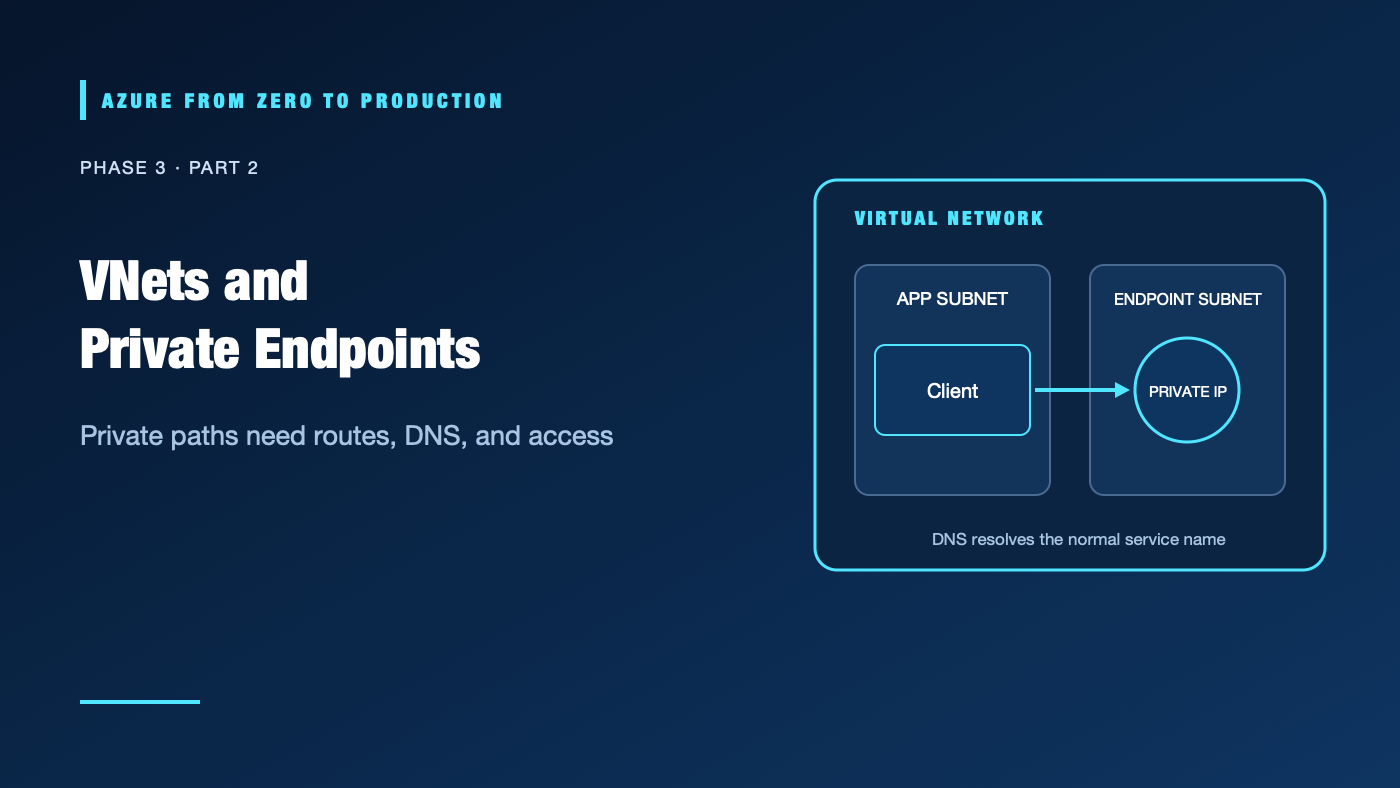
A database has “public access disabled,” but an application still cannot connect after a private endpoint is created. The endpoint exists; the hostname still resolves incorrectly from the app’s network. Private connectivity depends on address allocation, routes, DNS, service configuration, and identity working together.
What you’ll learn
- Distinguish a virtual network, subnet, NSG, route table, and NAT Gateway.
- Explain private endpoints versus service endpoints.
- Trace private DNS resolution to a private endpoint address.
- Identify network and identity permissions needed to connect.
- Inspect an existing VNet with read-only Azure CLI commands.
Where this fits
Module 11, Phase 3, Part 2. First read Networking Fundamentals. Next, Beyond One VNet: Hub-Spoke and Hybrid Azure Networking covers peering and hybrid connectivity.
Prerequisites
- Basic networking and Azure resource-group knowledge.
- Optional Azure CLI 2.91.0+ and Reader access to an existing network.
- No deployment permissions needed for the exercise; no resources are created.
- Cost: none.
The VNet is an address and routing boundary
An Azure virtual network (VNet) is a private IP address space in a region. Subnets divide that space into smaller ranges and provide attachment points for network interfaces and supported services. A VNet is not automatically isolated from every other VNet: peering, gateways, service integrations, and routes can connect networks.
VNet 10.40.0.0/16
├── app subnet        10.40.1.0/24 -> application workloads
├── endpoint subnet   10.40.2.0/24 -> private endpoint NICs
└── admin subnet      10.40.3.0/24 -> controlled operations
Choose non-overlapping CIDR ranges before deployment. Subnet requirements vary by service; some services reserve addresses or require delegation. Verify current requirements before creating production subnets.
An NSG contains ordered allow/deny rules evaluated against source, destination, port, and protocol. It can be associated with a subnet or network interface. An application security group (ASG) lets rules refer to groups of network interfaces instead of hard-coded IP lists. A route table adds user-defined routes (UDRs); it can steer traffic to a firewall, gateway, or other next hop.
NAT Gateway provides predictable outbound internet connectivity for associated subnets. It does not expose an inbound service or replace NSGs. Explicitly design outbound connectivity rather than relying on implicit defaults.
Private endpoints: private IP to a specific service resource
An Azure Private Link private endpoint is a network interface with a private IP in a VNet subnet. It connects to a specific supported service resource or Private Link service. The connection can require approval by the resource owner. The endpoint provides a private path; it does not grant data-plane permission.
Private DNS usually makes the service’s familiar hostname resolve to that private IP from linked networks. The private zone must match the service’s documented zone name and be linked to the client VNet, or be reachable through the organization’s DNS forwarding design. The client must use that DNS path.
Private endpoint versus service endpoint
- A private endpoint gives the service resource a private IP in your VNet, with traffic routed over Private Link. It supports private access patterns across connected networks, subject to service and network configuration.
- A service endpoint extends a VNet’s identity to a supported Azure service over its service endpoint route. The service still uses its public endpoint address; firewall rules can restrict access to selected VNets.
They are different features with different routing and DNS behavior. Choose based on the service, network topology, exposure requirements, and supported capabilities; do not enable both by habit.
Network, control-plane, and data-plane access
Creating a private endpoint is a control-plane operation. Reading a blob, secret, or database record is a data-plane operation. A private route answers “can packets reach the service?”; Entra ID and service authorization answer “may this identity use it?” All three must be correct.
Hands-on: inspect an existing VNet (read only)
Set the resource group and subscription context deliberately:
az account show --query "{name:name, id:id, tenantId:tenantId}" --output table
RESOURCE_GROUP="<EXISTING_RESOURCE_GROUP>"

az network vnet list --resource-group "$RESOURCE_GROUP" \
  --query "[].{name:name, addressSpace:addressSpace.addressPrefixes}" --output table

az network vnet subnet list --resource-group "$RESOURCE_GROUP" \
  --vnet-name "<EXISTING_VNET_NAME>" \
  --query "[].{name:name, prefix:addressPrefix, nsg:networkSecurityGroup.id}" --output table
Replace placeholders with a network you are authorized to inspect. Do not share outputs that reveal internal addressing publicly.
✅ Checkpoint: Identify the VNet prefixes, subnet prefixes, NSG associations, and whether ranges overlap with connected networks. This uses read operations only.
Security, cost, and production choices
Use private endpoints where the service should not be reachable through a public network path. Disable public network access only after all required clients can resolve and reach the private endpoint. Restrict subnet traffic and use identity-based data access where supported.
Private endpoints, NAT Gateway, gateways, firewall, and data transfer can incur costs. A private endpoint is billed independently of whether a client is actively sending traffic; verify current pricing and service limits. A low-cost learning configuration should use an existing VNet/client where possible. Production design additionally needs resilient DNS, centralized egress, route inspection, monitoring, and service-level failover planning.
Troubleshooting
- Hostname resolves to public IP: Private DNS zone is missing, unlinked, or not used by the client; inspect resolver configuration and zone link.
- Private IP resolves but connection times out: Check NSGs, UDRs, endpoint approval, service firewall, and whether the client shares a connected route.
- Endpoint is pending: The target resource owner must approve the connection; verify connection state and permissions.
- Connection works in one VNet only: DNS links, peering routes, forwarding, or NSG rules differ; compare each client path.
- Public access remains available: Endpoint creation does not disable the public endpoint; set the service’s public network setting and validate other allowed paths.
- Authorized user receives 403: Network reachability is not data permission; check the service’s data-plane role and tenant context.
- DNS broke for other clients: Avoid broad overrides of active public DNS zones; use the documented Private DNS zone and forwarding configuration.
Five-pillar readiness checklist
- Reliability: Keep DNS and private connectivity available across the intended client networks.
- Security: Close unnecessary public access, restrict flows, and separately authorize service data.
- Cost Optimization: Include endpoint, NAT, gateway, firewall, and egress charges in the design.
- Operational Excellence: Document VNet prefixes, private zones, links, approvals, and owners.
- Performance Efficiency: Place clients and endpoints thoughtfully; measure latency and throughput.
Cleanup
The read-only exercise creates nothing; no cleanup is needed.
Key takeaways
- A VNet is not an access policy by itself.
- Private endpoints provide a private IP path to a specific service resource.
- DNS makes the normal service hostname use that path.
- Network, control-plane, and data-plane permissions are distinct.
- Test from each relevant VNet and resolver.
Next: Beyond One VNet: Hub-Spoke and Hybrid Azure Networking.
Series navigation: Previous: Networking Fundamentals · Current: Phase 3, Part 2 · Next: Hub-Spoke and Hybrid Networking