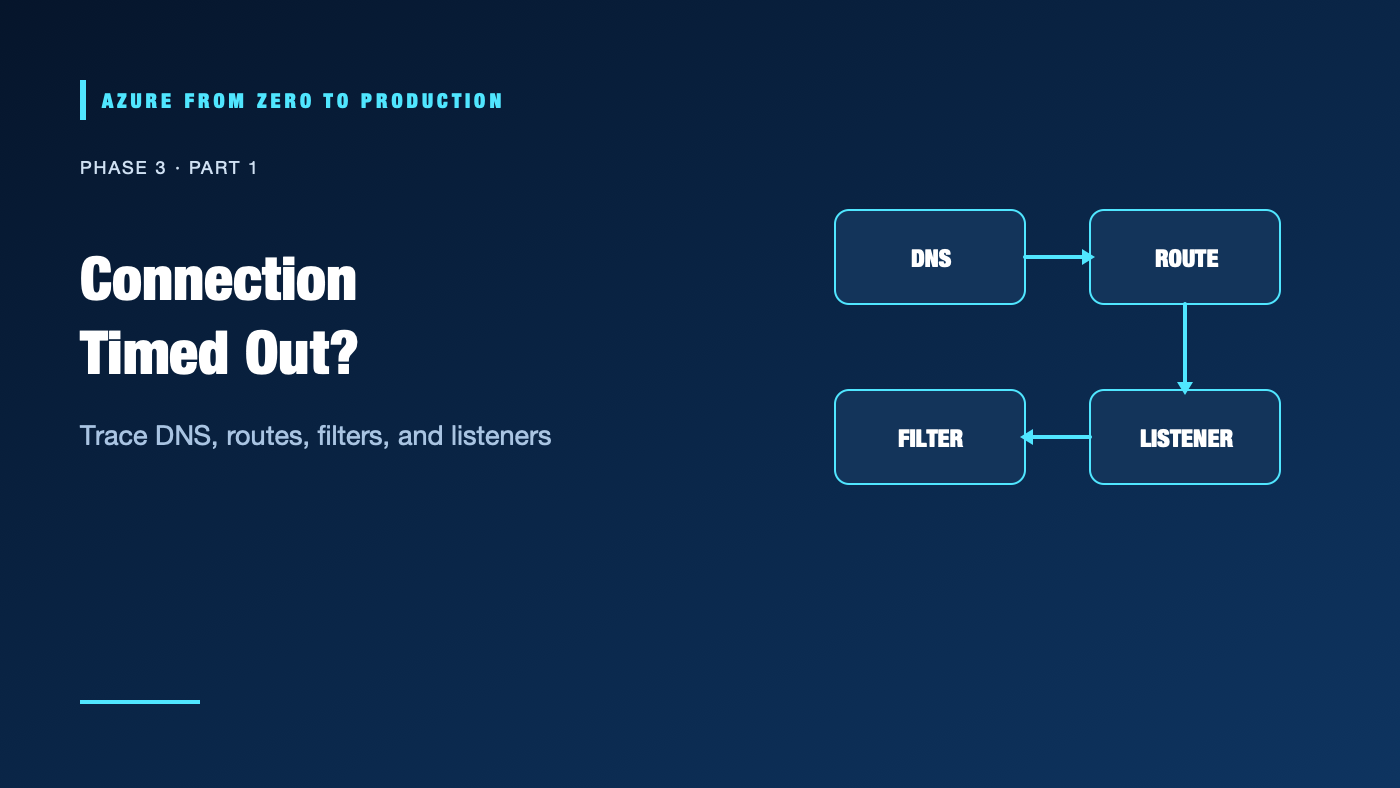
An application that worked yesterday now times out. The VM is running, the service is listening, and yet the request never arrives. “The network is broken” is not a diagnosis: the fault could be name resolution, routing, a firewall, a missing listener, or an unhealthy destination.
This article builds the concepts that make Azure troubleshooting systematic. The exercise uses local tools only; it creates no Azure resources.
What you’ll learn
- Read an IPv4 address and CIDR prefix, and explain subnet membership.
- Distinguish TCP failures from DNS and application failures.
- Trace a request through DNS, routing, filtering, and the destination listener.
- Explain public/private IPs, NAT, and Azure network security groups.
- Use a layered troubleshooting sequence instead of changing several rules at once.
Where this fits
This is Module 10 and Phase 3, Part 1. Phase 2 covered identity and authorization; this phase follows packets. Next, Azure VNets, Subnets, and Private Endpoints Explained applies these foundations to Azure network boundaries.
Prerequisites
- Basic terminal use and familiarity with Azure tenants, subscriptions, and resource groups.
- No Azure permissions or subscription are needed for the local exercise.
- Optional tools:
ip/ifconfig,dig/nslookup,curl, andtraceroute/tracert. - Cost: none; no cloud resources are created.
The path a request takes
Imagine a browser calling https://api.example.test/v1. The client resolves a name, opens a transport connection to an address and port, then sends an application request:
name lookup -> IP address -> route -> network filters -> TCP/TLS -> HTTP response
      DNS        destination  next hop   NSG/firewall     listener   application
Each arrow is a separate failure domain. A successful DNS lookup does not prove that the route exists. A successful TCP handshake does not prove the application returns a useful response.
Addressing and CIDR
An IPv4 address has 32 bits, written as four decimal octets, such as 10.20.4.17. A CIDR block adds the number of leading network bits: 10.20.4.0/24 contains 256 total addresses, from .0 through .255; usable host counts depend on platform reservations. A /16 is larger than a /24, because fewer bits are fixed for the network.
Subnets must not overlap where networks need to route to each other. Plan address space across VNets, peered networks, VPN-connected offices, containers, and future network connections before deployment. An overlapping range can make a route ambiguous even when each side works independently.
Private addresses are not internet-routable. Public addresses can be reached from the internet only when routing, firewall rules, and the service permit it. A public IP alone is not an authorization policy. NAT translates addresses; it does not, by itself, grant application access.
Ports, protocols, DNS, and routes
TCP provides a connection-oriented byte stream with delivery and ordering mechanisms. UDP sends datagrams without establishing the same kind of connection. Applications conventionally use ports such as TCP 443 for HTTPS, but a port number does not prove which program is listening.
For a TCP request to work, the destination needs a route, every applicable filter must allow the flow, a process must listen on the destination IP and port, and return traffic needs a valid path. Stateful firewalls commonly track the connection; stateless rules require careful consideration of both directions.
DNS maps names to records such as A/AAAA addresses and CNAME aliases. A laptop, VM, container, and private DNS forwarder may see different answers. DNS caching can temporarily preserve an old result.
Routing selects a next hop based on destination prefixes and route precedence. In Azure, system routes, user-defined routes, and gateway routes combine to influence a packet’s path. A route to a destination is not the same as permission to use that path.
Filtering, NAT, and load balancing
Azure network security groups (NSGs) filter traffic at subnet or network-interface scope using ordered rules. An application security group (ASG) lets rules refer to groups of network interfaces rather than hard-coded IP lists. Azure Firewall provides managed network and application filtering. A web application firewall (WAF) evaluates HTTP(S) requests; it does not replace network reachability controls.
Load balancers distribute traffic across healthy backends. A probe determines whether a backend should receive traffic, but the application still needs a working route and listener. NAT Gateway provides outbound internet connectivity for associated subnets; it is not an inbound publishing service.
Hands-on: diagnose a local endpoint
Use an endpoint you control, or substitute example.com for a basic test. No Azure resource or configuration change is involved.
HOST="example.com"
getent hosts "$HOST" 2>/dev/null || nslookup "$HOST"
curl --connect-timeout 5 --max-time 10 -I "https://${HOST}"
On systems without getent, run nslookup "$HOST" directly. Interpret each step independently:
- If name resolution fails, inspect the configured resolver and queried name.
- If resolution succeeds but
curlcannot connect, inspect route, proxy, firewall, destination port, and service availability. - If an HTTP status arrives, DNS and a TCP/TLS path worked; investigate the HTTP response and application behavior next.
✅ Checkpoint: Record whether the result is DNS-, connection-, TLS-, or HTTP-related. Do not “fix” a network by disabling the firewall.
Security, cost, and production choices
- Keep public exposure deliberate. Prefer private connectivity for services that do not need internet access.
- Use NSGs as narrow traffic filters, not as the only security boundary. Review effective rules and routes.
- Separate management access from application traffic; use approved private administration paths rather than broadly opening SSH/RDP.
- Use Entra ID and Azure RBAC to control who can change network resources. Network reachability is not identity authorization.
- Avoid overlapping address spaces, unrestricted inbound rules, and undocumented static routes.
The local exercise is free. Azure networking can incur hourly and data-processing charges for public IPs, NAT Gateway, VPN/ExpressRoute gateways, Azure Firewall, load balancers, private endpoints, and outbound data transfer. Verify current regional prices and minimum deployment requirements before provisioning.
For production, document the address plan, DNS ownership, allowed flows, route propagation, egress path, and failure owner. Test from the same network location as the affected workload; a developer laptop is not a faithful substitute for a container subnet.
Troubleshooting patterns
- Name does not resolve: Wrong DNS zone, resolver, or record; query the expected DNS server and inspect the record chain.
- Name resolves to an unexpected address: Stale cache or split-horizon DNS; compare resolver answers and flush only the relevant cache.
- TCP times out: Packet dropped, route missing, or destination unreachable; check routes and effective NSG/firewall rules at each hop.
- Connection is refused: Destination is reachable, but no listener accepts the port or a host firewall rejects it; verify process binding and local firewall.
- Intermittent failures: Unhealthy backend, asymmetric routing, exhausted connection pool, or changing DNS answer; correlate timestamps with probes and logs.
- TLS error after connection: Hostname/SNI mismatch, expired or untrusted certificate, or protocol mismatch; inspect certificate chain and requested hostname.
- Works from one subnet only: Subnet-specific routes, DNS links, or NSG rules differ; compare effective routes and policy rather than copying all rules.
Five-pillar readiness checklist
- Reliability: Identify alternate paths and test how DNS and backends behave during a failure.
- Security: Restrict ingress/egress and separate network reachability from Azure RBAC.
- Cost Optimization: Prefer the simplest network service that meets the requirement; model hourly and transfer charges.
- Operational Excellence: Keep an address/flow diagram and a repeatable, layered diagnostic runbook.
- Performance Efficiency: Measure latency at the client and service; choose regions and paths from observed demand.
Cleanup
No Azure resources were created, so no cloud cleanup is needed. No local files were written.
Key takeaways
- Troubleshoot in layers: DNS, route, filters, transport, TLS, then application.
- A name resolving is not proof of connectivity or authorization.
- CIDR planning prevents routing conflicts later.
- Network controls should be explicit and narrowly scoped.
- Test from the workload’s actual network location.
Next: Azure VNets, Subnets, and Private Endpoints Explained.
Series navigation: Previous: Azure Policy and Defender for Cloud · Current: Phase 3, Part 1 · Next: Azure VNets and Private Endpoints
Technical details and prices change. Verify current Azure documentation and regional availability before implementation. This exercise has not been run against an Azure subscription.