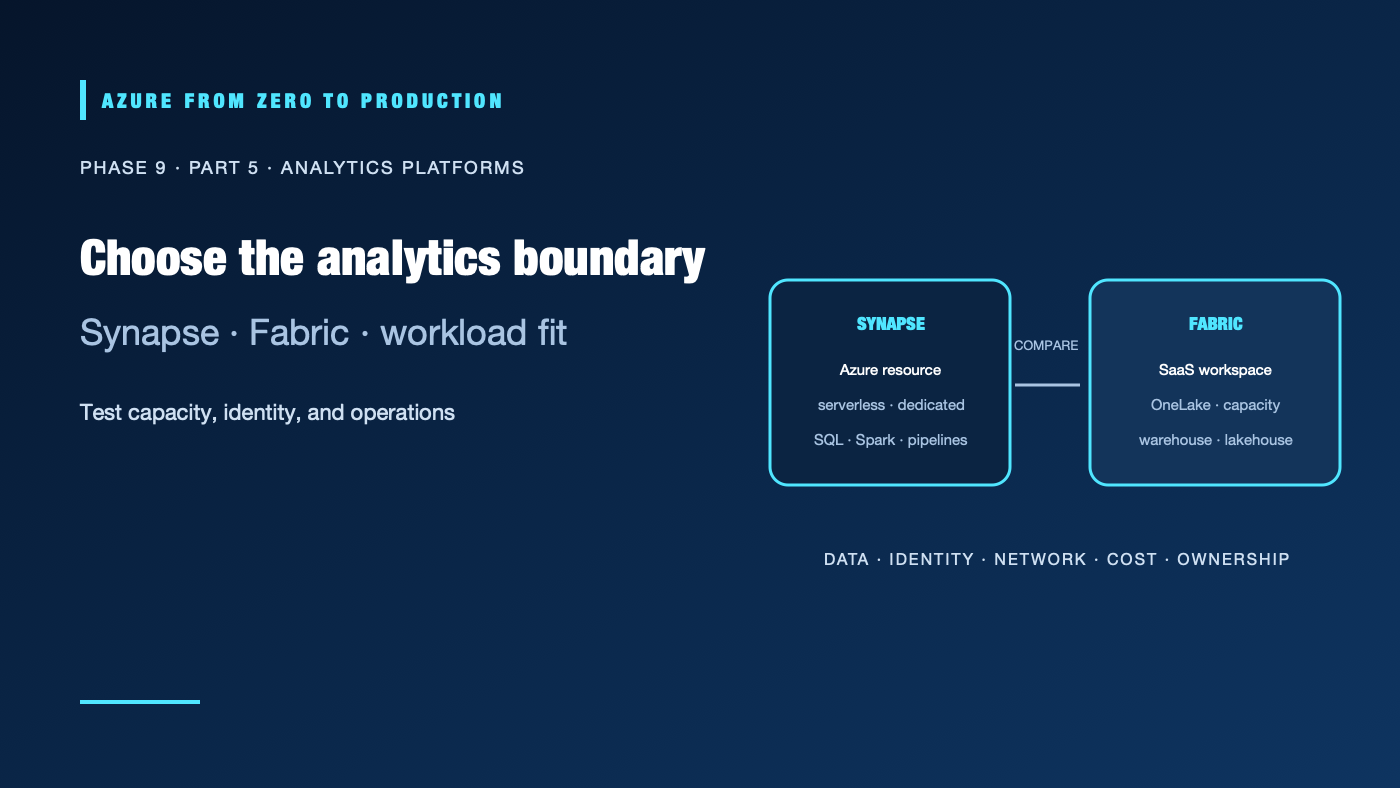
“We need a data warehouse” can describe several different needs: governed SQL models, ad hoc lake queries, high-concurrency reporting, Spark transformations, or a self-service analytics platform. Azure Synapse and Microsoft Fabric both address analytics, but they have different workspace boundaries, compute models, deployment paths, and prerequisites. A platform choice should follow the workload and organization’s operating model.
What you’ll learn
- Compare Synapse dedicated SQL pools, serverless SQL, Fabric Warehouse, and Fabric Lakehouse.
- Understand OneLake and Fabric capacity as architectural dependencies.
- Choose workspace boundaries, ingestion paths, and modeling patterns.
- Identify tenant, license, capacity, and governance prerequisites.
- Plan a representative proof of concept instead of relying on feature checklists.
Prerequisites
- Basic SQL, data lake, and analytical workload concepts.
- A Fabric trial or capacity is not required for this comparison.
- Fabric capacity and Azure Synapse resources have separate commercial and billing considerations; verify current eligibility and pricing.
Start with the workload
| Option | Useful when | Important tradeoff |
|---|---|---|
| Synapse serverless SQL | Query supported files in a lake without provisioning a dedicated SQL pool | Scan-based cost and workload/concurrency fit need testing |
| Synapse dedicated SQL pool | A provisioned distributed SQL warehouse and its workload controls fit the model | Capacity is provisioned and requires pause/scale and workload management |
| Fabric Warehouse | A managed relational analytics experience with SQL and Fabric-native integration fits the organization | Fabric capacity, workspace governance, and Fabric-specific deployment patterns are prerequisites |
| Fabric Lakehouse | OneLake files, Spark engineering, and SQL analytics need to coexist in a Fabric workspace | Lakehouse table/SQL semantics and capacity behavior differ from a traditional dedicated warehouse |
The table is a starting point, not a guarantee that every feature, connector, region, or security integration is equivalent. Compare required SQL behavior, concurrency, data volumes, latency, incremental loads, access model, recovery, observability, and deployment automation using the actual workload.
Understand the Fabric boundary
Microsoft Fabric is a SaaS analytics platform organized around Fabric workspaces and capacity. OneLake provides a tenant-wide logical data lake with workspace-oriented organization. Fabric workloads consume capacity and use Fabric identities, permissions, and governance features. A Fabric license or trial is not the same thing as an Azure subscription, and the existence of an Azure tenant does not guarantee that the needed Fabric capacity or feature is enabled.
Azure Synapse is an Azure resource and includes multiple analytics experiences, such as serverless SQL, dedicated SQL pools, Spark pools, and pipeline integration. Teams may already have Synapse-managed networking, private endpoints, role assignments, deployment workflows, and Azure Monitor practices. A move to Fabric changes boundaries and should include a deliberate identity, data-movement, network, cost, and operations review.
Choose an organizational fit
Choose Synapse when a required Synapse capability or existing Azure-native boundary is important and the team can operate it. Choose Fabric when its integrated SaaS experience, OneLake, workspace model, and capacity governance fit the users and operating model. A mixed design can be valid, but every cross-platform copy creates another data path to secure, reconcile, and pay for.
Model data once in a way that supports the desired consumers. Define authoritative tables, naming and schema standards, workload isolation, and access owners. Keep development, test, and production workspaces or resources separated according to the organization’s deployment policy. Use source control and promote tested definitions; do not make a manually edited production workspace the only source of truth.
Run a small proof of concept
Use a representative dataset and query mix. Measure load duration, incremental update behavior, query latency at realistic concurrency, data scan/compute consumption, and recovery after a failed job. Test the actual identity and network path. Include a service owner and a billing owner in the evaluation; capacity is a shared operating decision, not just a developer setting.
Document which feature is mandatory, which is an assumption, and what could change the decision. Recheck region availability, preview status, feature limits, licensing, and pricing before production adoption because these evolve.
✅ Checkpoint: For a candidate platform, state its storage, compute, capacity or pricing model, tenant prerequisites, access model, deployment boundary, primary query SLA, and measured proof-of-concept result.
Next: Spark on Azure and Databricks.
Series navigation: Previous: Synapse serverless SQL · Current: Phase 9, Part 5 · Next: Spark on Azure