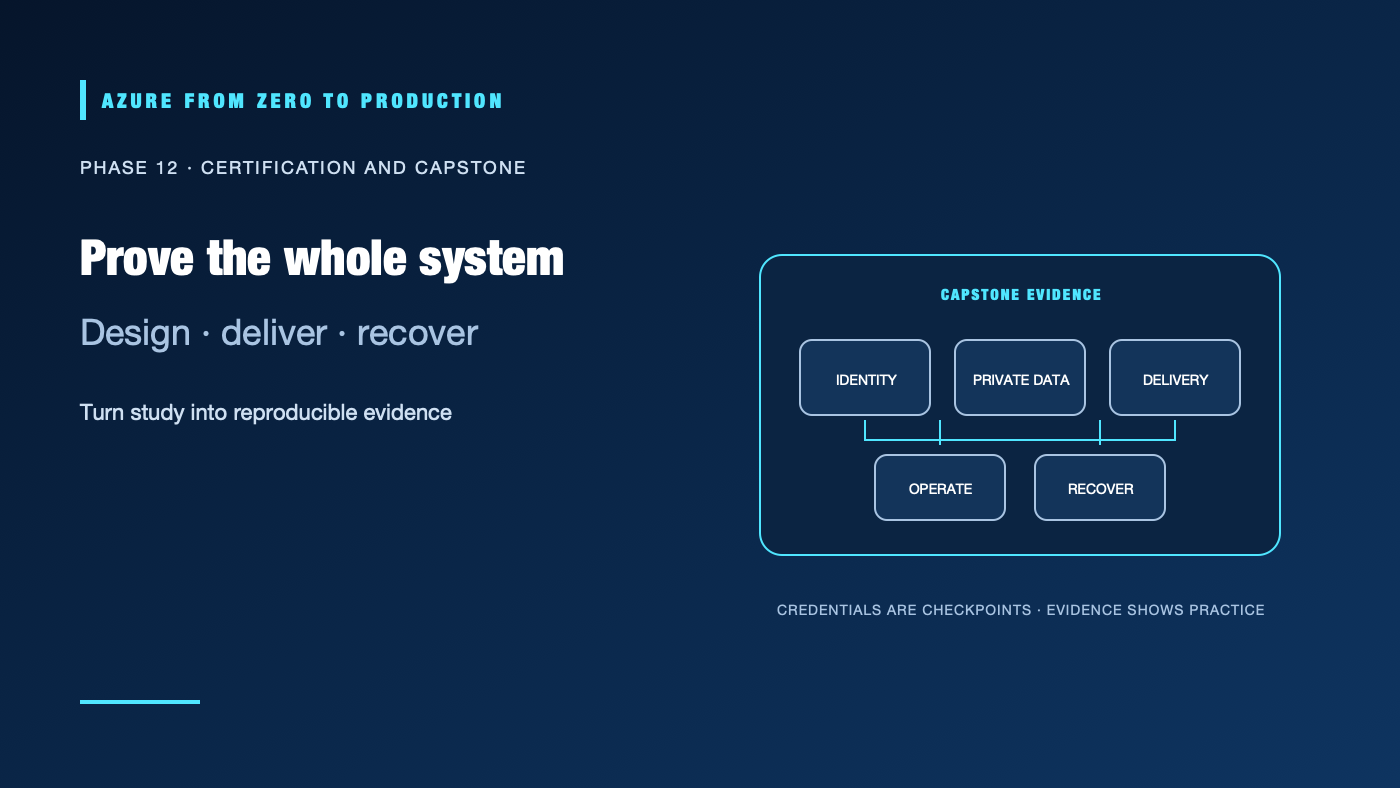
A certification can structure study and demonstrate that you met a published exam standard. It cannot prove that you have operated a workload, recovered its data, or kept its access and cost under control. Use the learning path in two ways: choose a current credential that matches your role, and build a portfolio capstone whose evidence shows how you make engineering decisions.
What you’ll learn
- Map Azure learning goals to current Microsoft credentials without treating any exam as mandatory.
- Check current prerequisites, exam guides, retirement dates, renewal rules, and registration details.
- Combine the series labs into a bounded, production-shaped capstone.
- Define evidence for security, deployment, testing, recovery, cost, and cleanup.
- Present sanitized portfolio work without exposing secrets or customer data.
Prerequisites
- Completion of the Azure learning path or equivalent hands-on experience.
- A Git repository and access to a disposable development subscription are useful for the capstone.
- Certification exams, training, Azure resources, and test deployments can incur costs.
Choose credentials by role
The following Microsoft credentials and exams were listed on Microsoft Learn when this roadmap was reviewed on 2026-11-01. They are optional study directions, not prerequisites to building the capstone. Exam names, availability, objectives, and prerequisites change; verify each linked credential page before you register.
| Goal | Credential and exam | Where this series helps |
|---|---|---|
| Learn core cloud and Azure concepts | Microsoft Certified: Azure Fundamentals (AZ-900) | Phase 1 introduces cloud concepts, regions, core services, governance, and cost. |
| Learn AI concepts without starting with model operations | Microsoft Certified: Azure AI Fundamentals (AI-901) | Phase 11 covers ML concepts, generative AI, embeddings, retrieval, and evaluation. |
| Operate Azure environments | Microsoft Certified: Azure Administrator Associate (AZ-104) | Phases 1–8 build foundations in identity, networking, compute, storage, IaC, delivery, monitoring, and operations. |
| Design Azure solutions | Microsoft Certified: Azure Solutions Architect Expert (AZ-305) | Phases 3–10 cover network, data, reliability, recovery, governance, and architecture trade-offs. Microsoft currently lists AZ-104 as a prerequisite certification. |
| Deliver and operate software | Microsoft Certified: DevOps Engineer Expert (AZ-400) | Phases 2, 4, 6–8, and 10 cover federated access, deployment, automation, security, monitoring, and resilience. AZ-104 is one current prerequisite route; check the credential page for all accepted prerequisites. |
| Build AI solutions on Azure | Microsoft Certified: Azure AI Cloud Developer Associate (AI-200) | Phases 4, 7–11 contribute application, SDK, data, monitoring, eventing, vector search, and AI skills. Review the current AI-200 study guide rather than relying on retired AI exam material. |
| Specialize in Fabric data engineering | Microsoft Certified: Fabric Data Engineer Associate (DP-700) | Phase 9’s pipeline, lake, Spark, governance, and quality work is relevant when your target platform is Fabric. This credential is Fabric-specific, not a general certification for every Azure data service. |
You do not need AZ-900 before taking a role-based exam. For architecture and DevOps credentials, check prerequisites before scheduling: AZ-305 requires Azure Administrator Associate, and AZ-400 requires an accepted Azure associate certification. The Azure Developer alternative can change status, so use the live AZ-400 page and prefer an active prerequisite such as AZ-104 when it fits your role.
The older Azure AI Engineer Associate (AI-102) page is marked retired. Do not buy an exam voucher or follow an old study plan based on an archived page. For AI, compare the current AI-901 and AI-200 scopes and choose the one aligned with your experience. The DP-700 credential targets Microsoft Fabric; it is not a renamed Azure Data Engineer exam.
Build a study plan that survives exam changes
- Start from the role. Read the credential’s skills outline and prerequisite list. Select one exam; do not collect credentials without a work goal.
- Compare the study guide with your evidence. Mark each objective as practiced, understood but not practiced, or unfamiliar. Use official learning paths and hands-on labs to close the gaps.
- Use a feedback loop. Take a current practice assessment, investigate weak objectives, and repeat after practice. A practice score is a study signal, not a guarantee of an exam result.
- Schedule only after checking status. Confirm the exam is active, its language and delivery options, price in your region, registration identity, and any required credential prerequisites.
- Plan renewal. Many role-based certifications require periodic renewal. Microsoft Learn offers online renewal assessments for eligible credentials; check the credential page for its cadence and eligibility. Fundamentals credentials can follow different rules.
Keep a small record of the exam version, the official study guide’s update date, and your next renewal date. If an exam retires while you are preparing, compare the replacement objectives instead of assuming they are equivalent.
Capstone: Operate a small business workflow
Build a synthetic order or service-request application that uses only the Azure components needed for its requirements. A reasonable baseline combines:
- A containerized API with a health endpoint and automated tests.
- A private managed database and a private application-to-data network path.
- Governed object storage and a small ingestion/transformation pipeline using synthetic records.
- Bicep or Terraform to define the environment repeatably.
- A delivery workflow using federated identity, scoped permissions, and an approval boundary for deployment.
- Application telemetry, a useful dashboard, and at least one actionable alert.
- An architecture decision record for one partial-failure scenario, recovery target, and cost/performance trade-off.
Use the event-driven and RAG topics only where they solve a real requirement. If you add a queue, define idempotency and dead-letter handling. If you add a RAG feature, use synthetic documents, enforce document access before retrieval, validate citations, test missing context and prompt injection, and record its cost. Neither feature is required merely to make the capstone look more complex.
Suggested implementation sequence
- Design: Draw the request, identity, network, data, and deployment paths. Write down the data classification, threat boundaries, user-visible SLO, expected monthly cost, recovery objective, and cleanup owner.
- Provision: Deploy into a dedicated sandbox using one IaC tool. Keep state and pipeline permissions protected. Use managed identities or workload federation; do not commit credentials.
- Deliver: Build and test the API and data pipeline in CI. Deploy through a federated identity and an approval-controlled environment. Record a rollback path.
- Operate: Generate safe test traffic, inspect telemetry, trigger a controlled alert, and confirm the team can find the relevant logs. Do not expose a production service to create test failures.
- Recover: Restore a backup or rehearse the service-supported recovery procedure in an isolated environment. Record observed recovery time, data loss or reconciliation, and any difference from the target.
- Review and remove: Compare estimated and observed cost, remove lab-owned resources and role assignments, and verify that no billable resource remains.
Do not perform a live failover, delete data, or deploy paid resources outside an approved subscription and change window. If a cloud exercise is not authorized, test the IaC and application locally and clearly label recovery results as a design exercise rather than live evidence.
Acceptance criteria and portfolio evidence
The capstone is complete when a reviewer can reproduce or inspect the evidence for each item:
- Architecture: diagram, data flows, trust boundaries, and a short decision record explaining what was deliberately excluded.
- Infrastructure: successful Bicep build/what-if or Terraform format/validate/plan checks, with no secrets in state or source control. Include deployment evidence only if a sandbox deployment was approved.
- Identity and security: scoped role assignments, private connectivity evidence, protected CI federation, and a clear statement of what the application identity can access.
- Application and data: automated API tests, one authorization-denial test, a pipeline quality check with expected counts, and sample outputs using synthetic data.
- Delivery and operations: CI results, approval and rollback evidence, dashboard/alert screenshots with sanitized data, and an incident or recovery runbook.
- Reliability and cost: a failure scenario, target and observed RTO/RPO if a restore was run, largest cost drivers, cost per useful operation, and one measured improvement or justified non-change.
- Cleanup: resource inventory before and after cleanup, deleted lab-only resources, and removed temporary permissions.
Publish a README, sanitized architecture diagram, IaC, test summaries, and short runbooks. Never include access tokens, private keys, subscription identifiers, personal data, customer logs, or unredacted portal screenshots. If evidence cannot be shared publicly, provide a redacted summary and explain the limitation.
✅ Checkpoint: Name the role credential or AI/data path you chose, link its live study guide, show one artifact proving each capstone acceptance criterion, and state which deployment, recovery, cost, or cleanup steps were actually executed.
Series navigation: Previous: Build and evaluate a small RAG application on Azure · Current: Phase 12, Part 1 · End of series.
References
- Microsoft credentials and certifications
- Microsoft Certified: Azure Fundamentals
- Microsoft Certified: Azure AI Fundamentals
- Microsoft Certified: Azure Administrator Associate
- Microsoft Certified: Azure Solutions Architect Expert
- Microsoft Certified: DevOps Engineer Expert
- Microsoft Certified: Azure AI Cloud Developer Associate
- Azure AI Engineer Associate (retired)
- Microsoft Certified: Fabric Data Engineer Associate
- Renew your Microsoft certification